
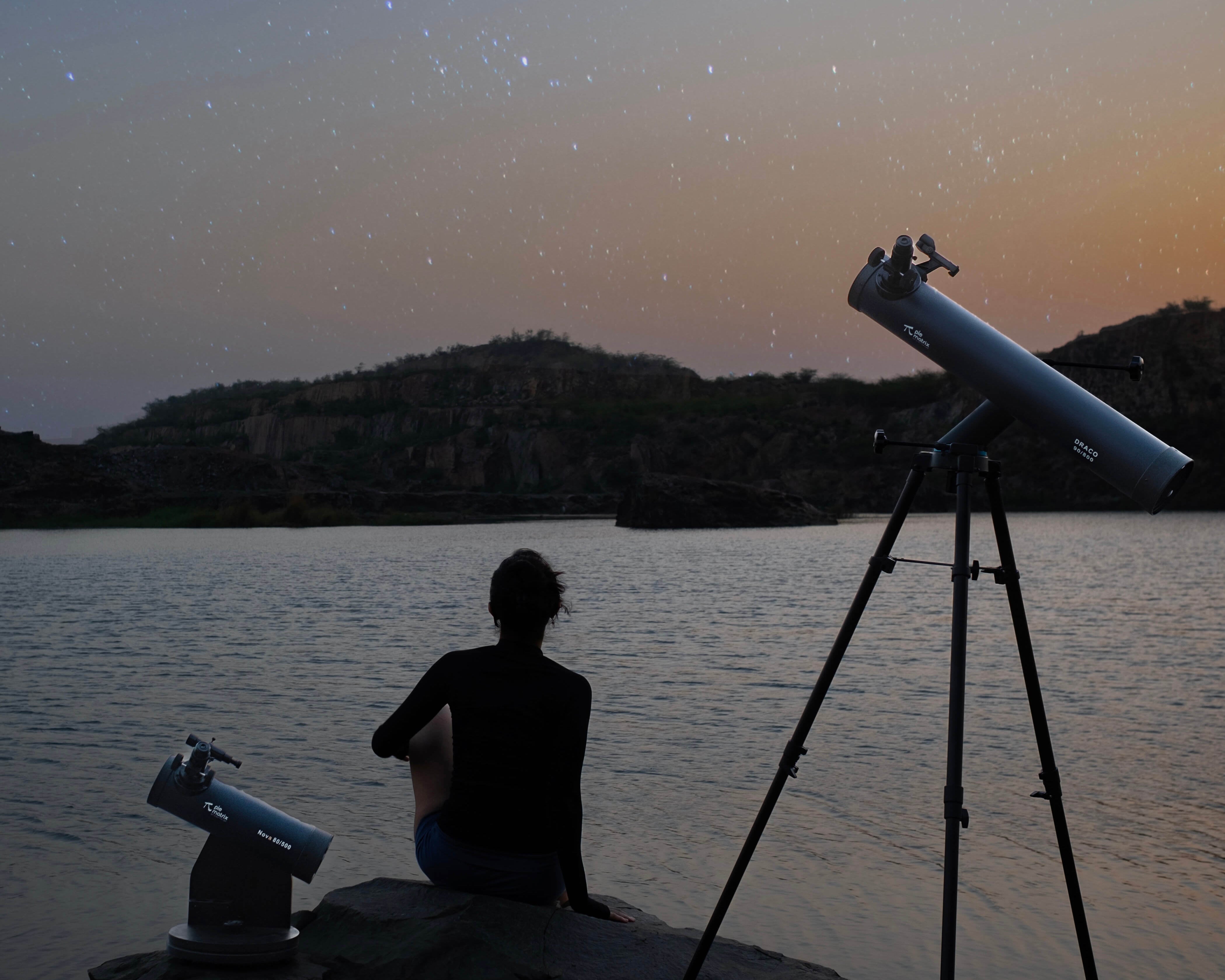
Do you need an extraordinary telescope to see the Moon on a clear night? Not really. Set up a basic good quality telescope and you’ll see craters. Turn it towards Jupiter and four tiny dots line up beside the planet, four of its largest moons. Saturn’s rings too, to some extent (clarity depends). Yes, you read it right!
Magnification numbers on the box doesn’t necessarily help in choosing the best telescope for viewing planets and the moon. The choice comes down to five things working together and it’s the aperture, focal length, optical quality, mount stability and ease of use.
What Aperture Is Best for Planets and the Moon
Aperture is just the diameter of the main lens or mirror. It’s the main source of light-gathering. Bigger aperture means more light comes in and more light means you can check out finer detail.
Here are a few useful ranges for Moon and planetary observation:
|
Aperture |
Best suited for |
Typical use |
|
50-70mm |
Beginners |
Moon and Big Planets |
|
70-100mm |
Beginners & hobbyists |
Moon, Moon craters and Big Planets |
|
100-130mm |
Enthusiasts |
Planet Observation |
|
150mm+ |
Experienced observers |
Planet, galaxy and nebulas |
Don’t assume the biggest telescope automatically wins here. A 150mm reflector is heavy and it can become a real pain to carry out every time you want to look up. A good 70-100mm telescope still shows you Saturn’s rings and Jupiter’s cloud bands and easy portability is the bonus. So, while choosing the best telescope for viewing planets and the moon, keep portability in mind too.
What Focal Length Is Best for Planetary Viewing
Focal length is the distance between the telescope’s main optical element and the point where light actually comes to focus.
Want more exposure to your eyepieces for planetary work? A longer focal length gets you there. That said, focal length by itself won’t make or break the view, it works alongside aperture and optical quality too.
For example, the Pie Matrix Draco 90/800. It pairs a 90mm aperture with an 800mm focal length, a combo that handles both lunar and planetary targets well. Don’t chase one number while choosing the best telescope for viewing planets and the moon. Aperture, optics, focal length and a mount that holds steady, you need all four pulling together.
What Is the Best Telescope for Jupiter and Saturn
Jupiter and Saturn top most beginners’ lists. With a suitable telescope, Jupiter on a clear night can be seen with its bright disk, the major cloud bands and the four Galilean moons lined up beside it. Saturn’s the real showstopper, honestly. Its rings become visible through a modest amateur telescope. Pie Matrix has a handful of models built for this kind of viewing: Pegasus, Draco, Helix, Neo, Phoenix. Before you buy, look for:
-
Good optics
-
Adequate aperture
-
A stable mount
-
Suitable focal length
-
Eyepieces
Which Telescope Is Best for Moon Viewing
The Moon is the perfect first target once you get a telescope home. Refractors are usually the easiest ones for lunar viewing. Setup takes a couple of minutes and the images come out sharp. Pie Matrix’s Phoenix refractor range is built with exactly this in mind, solid, beginner-friendly options for the Moon and other bright targets. Depending on your telescope, you can observe:
-
Impact craters and mountains
-
Valleys and lunar seas
-
The terminator between light and shadow
How Much Magnification Do You Need to See Planets
Beginners tend to choose a telescope on magnification first. But, higher magnification isn’t automatically better, though. Excessive magnification can make the image dim, and blurry before you can get it in focus.
What counts as “useful” magnification depends on aperture, optical quality, atmosphere condition and eyepiece. Here is a better way to approach:
-
Start with lower magnification
-
Focus on the object
-
Increase magnification gradually
-
Stop when the image loses sharpness
Work through those steps and you’ll have the highest magnification your setup can actually handle.
Refractor vs Reflector for Planetary Viewing
Both refractors and reflectors can give you excellent views of planets and the Moon. Where they really diverge is given below in the table for better decision making.
|
Feature |
Refractor |
Reflector |
|
Optical System |
Lenses |
Mirrors |
|
Setup |
Generally simple |
Simple to moderate |
|
Planetary Viewing |
Excellent |
Excellent |
|
Maintenance |
Generally low |
May require more care |
|
Large Aperture |
Can be expensive |
Often more affordable |
Refractors give sharp views and are simple to use. Reflectors trade some of that simplicity for bigger apertures at a lower price. Pie Matrix has both types.
What Can You See With Different Telescope Sizes
Size determines two things. One is how much light a scope pulls in and second is how much fine detail it can show you. Start small and you’ll still get real views, the Moon’s craters, Jupiter’s cloud bands, Saturn’s rings. A 90-100 mm telescope sharpens that resolution up a notch. Step up to 150mm telescope and the light-gathering capability jumps considerably. That’s the tradeoff that drives most upgrade decisions.
Bigger apertures also open the door to see star clusters, nebulae, galaxies, but their weight affects the portability.
Is a Dobsonian Good for Planets
Yes. Dobsonians pair big apertures with simple mounts, which is exactly what planetary viewing is rewarding. A 6-inch or 8-inch Dobsonian will show you sharp lunar craters and planetary detail, while also allowing star clusters and galaxy exploration.
Pie Matrix has the Olympus 6-inch and the Titan 8-inch, so you’ve got two solid sizes to pick between.
What Is the Best Telescope for Beginners to See Planets and the Moon
Clear optics, enough aperture, a mount that holds steady, and controls simple enough to use in the dark and you’ve got the real checklist for the best telescope for viewing planets and the moon.
A refractor is an ideal choice. Just grab it, set it up and start observing. Want more reach? A reflector or Dobsonian gives you more aperture to explore deep-sky targets. The final choice depends on your budget, observing goals and how often you will use the telescope.
Choosing the Best Telescope for Planets and the Moon
Before you choose, don’t forget to check this list:
-
Your budget
-
Desired aperture
-
Portability
-
Ease of setup
-
Planetary vs deep-sky interests
-
Manual operation vs tracking
Bigger isn’t always better when you’re picking a telescope for planets and the Moon. That eye-catching “700x magnification” printed on the box comes under the marketing part. Aperture size, the quality of the optics, the focal length and a steady mount is what you should consider.
Get the setup right, and you’ll start noticing details you didn’t expect. Pie Matrix stocks up refractor, reflector, and Dobsonian telescopes, so there’s a model built for whatever you’re hoping to observe. If you’re still looking for the best telescope for viewing planets and the moon, visit the Pie Matrix Experience Centre to have hands-on experience and choose for yourself.
Share:
Choosing the Best Telescope for Beginners in India in 2026