
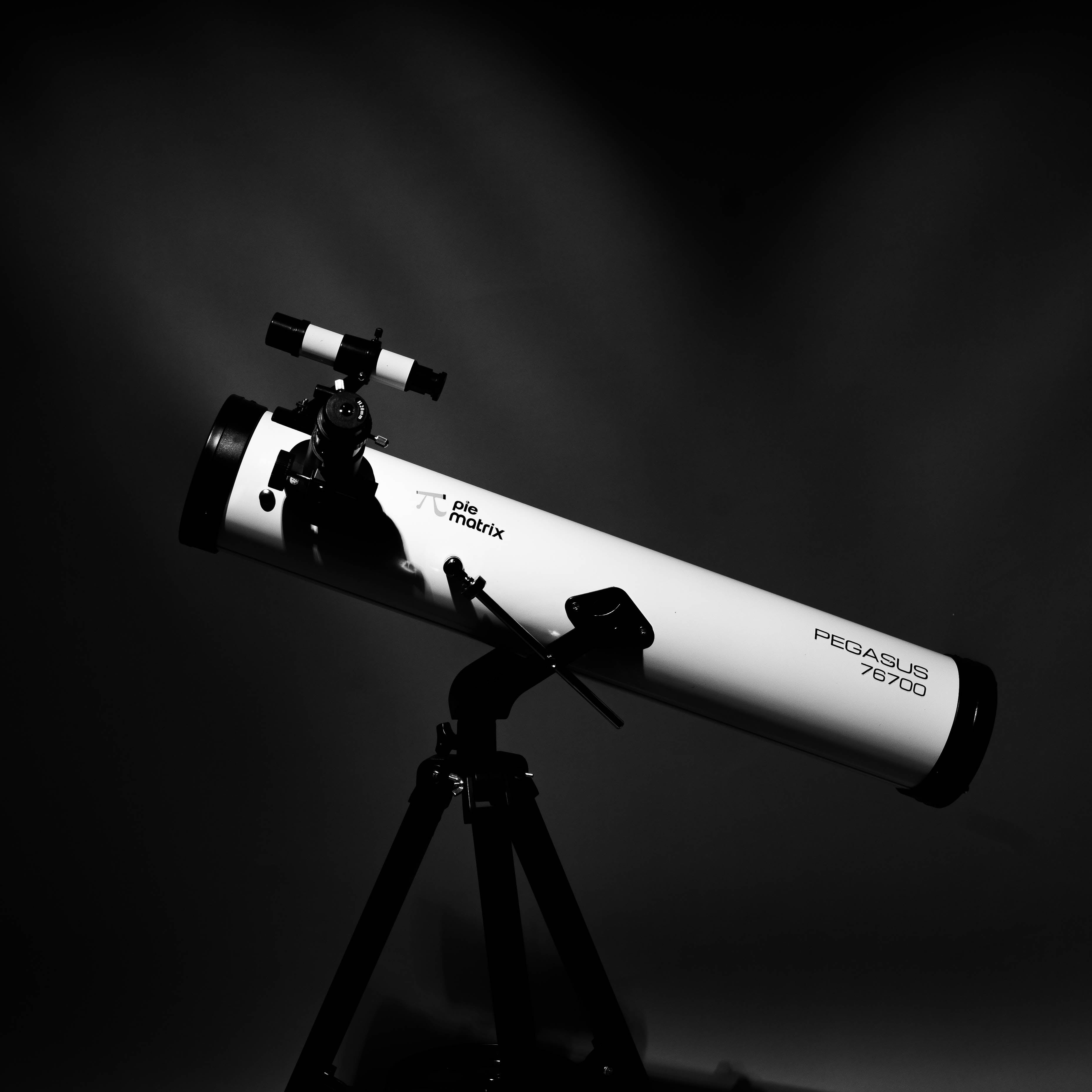
Are you struggling to choose between reflector and Refractor Telescope for spotting exclusive deep-sky magic? Galaxies stretch light with nebulae glow, and nebulae glow, all hazy and soft, and star clusters pop with killer contrast. Not in mega zoom, so which telescope grabs extensive light to deliver a crystal-clear image?
Refractor Telescopes shine, but glass limits their light-grabbing stability. However, reflector telescope scoop up huge amounts of light with mirrors, perfect for deep-sky wonders.
Which telescope from The Pie Matrix is the right choice for you to capture deep-sky views without any hassle? We offer compact designs for individual telescopes to beat bulky reflectors in portability and make them a favourite among astronomers.
Refractor Telescope: Benefits and Limitations
A Refractor Telescope is great for beginners, using lenses to give you crystal-clear, high-contrast views of planets and stars.
Know how this telescope works,
- The Objective Lens: Helps collect and bend incoming light, like big eye-catching photons.
- Focal Length: The light travels a certain distance to a point where it converges, creating a sharp image.
- Eyepiece: It magnifies this image, making distant objects appear closer.
● Types of Refractors
Larger apertures mean sharper, brighter images, so the bigger, the better! There are two main types:
- Achromatic: These Refractor Telescopes are budget-friendly and reduce colour distortion.
- Apochromatic (Apo): Apo refractors are top-notch, offering exceptional colour correction for the pros.
● Benefits and Disadvantages of Refractor Telescope
|
Advantages |
|
|
Limitations |
|
Reflector Telescope and Pros and Cons
Are you into exploring distant galaxies and nebulae? Reflector telescopes are your best companions. This uses mirrors to gather and focus light, offering you amazing views of the cosmos.
● How the Reflector Telescope Works?
- Primary Mirror: This mirror is concave, collecting and reflecting light like a big bowl.
- Secondary Mirror: A secondary mirror redirects this light to the eyepiece, where it is magnified.
● Reflectors Types
- Newtonian Reflectors: Affordable and versatile, great for stargazing.
- Schmidt-Cassegrain (SCT) Reflectors: Compact with a long focal length, perfect for planetary views.
- Maksutov-Cassegrain Reflectors: High contrast and sharp, ideal for planetary peeps.
- Dobsonian Reflectors: Large aperture, budget-friendly, and perfect for deep-sky viewing.
● Pros and Cons of Reflector Telescopes
|
Benefits |
|
|
Limitations |
|
What are the Key Differences between Refractor and Reflector Telescopes?
|
Differences |
Reflector telescopes |
Refractor Telescopes |
|
Affordable and large apertures are good for faint deep-sky images. |
Promotes excellent light transmission but is limited in size. |
|
Diffraction spikes, brighter views with coma at fast focal ratios. |
Sharp and contrast-rich pictures. |
|
Tubes and mirrors are sensitive to humidity and dust. |
More robust, so they need minimal upkeep (cleaning). |
|
Reflector telescopes need regular collimation (alignment) to stay sharp. |
These telescopes require less collimation and low maintenance.
|
|
Reflectors gather more light for a perfect sky view. |
It does not gather sufficient light, but it is a great choice for planetary viewing. |
Which Telescope Actually Wins for Deep-Sky Viewing?
Reflector telescopes shine when it comes to bigger apertures, using mirrors instead of bulky lenses. This makes them more practical and affordable, giving you brighter views and more detail before it gets lost in the dark. When choosing between telescopes online, this balance of performance and cost is often the deciding factor.
Refractor Telescopes, on the other hand, can struggle with chromatic aberration. Colours split around bright objects. It is not a big deal for casual stargazing, but it is distracting while you are trying to observe delicate deep-sky structures.
If astrophotography is your goal, refractors are a great choice. Optic design of The Pie Matrix’s refractors is perfect for capturing celestial objects, including galaxies and nebulae in deep space.
However, reflector telescopes from The Pie Matrix are ideal for beginners or those interested in brighter objects such as the moon or planets. They are a great starting point for exploring the cosmos.
Observe Deep-Sky with the Right Telescope
To capture deep-sky views, including galaxy clusters and far-off galaxies, you must go for a reflector telescope. Actually, reflector vs. Refractor Telescope selection depends on your aesthetic preferences, including budget goals and observing style.
Refractor Telescopes shine sharply and provide colour-accurate images, ideal for the Moon, planets, and astrophotography. Conversely, reflector telescopes offer unmatched aperture to observe deep-sky views and support strong astrophotography.
Ready to start the cosmic adventure? Order the best telescope online from The Pie Matrix today and support meaningful exploration of the night sky—contact us now to begin your journey!
Share:
Why Is a Reflector Telescope a Popular Choice Among Small Telescopes?
Beyond the Naked Eye: Choosing Your First Astronomical Telescope in 2026